Do You Hear What I Hear?
A virtual reality experience simulating what it’s like to live with hearing loss.
Do You Hear What I Hear? (DYHWIH) is a Virtual Reality adventure aimed at users who are the friends/loved ones/associates of people that are hard of hearing, in the hopes of building empathy towards the hearing impaired. DYHWIH allows the user/learner to fully experience what it is like to live with a variety of different hearing impairments by taking part in a number of mundane everyday activities, but with the audio adjusted to simulate a variety of types of hearing loss.
Learning objectives
After taking part in DYHWIH, users should be able to explain why people with hearing loss may get frustrated at times during spoken interactions with others. Users should develop the self-knowledge to recognize when they are engaging in a behavior that creates a communication difficulty (such as speaking to a hard-of-hearing person from a distance in a noisy environment).
Why VR?
“Empathy is different from seeing in perspective, which is to see from a critical distance, to detach ourselves in order to see more objectively. With empathy, we see from inside the person’s worldview; we walk in their shoes; we fully embrace the insights that come with engagement”
(Wiggins, and McTighe 98).
Virtual Reality makes it easy to zoom in on the Human Dimension and Caring taxons of Fink’s Taxonomy specifically.
Sample Scenarios
- Grocery Checkout
- Phone Call
- Loud Restaurant With A Large Group Of Friends
- Doctor’s Office
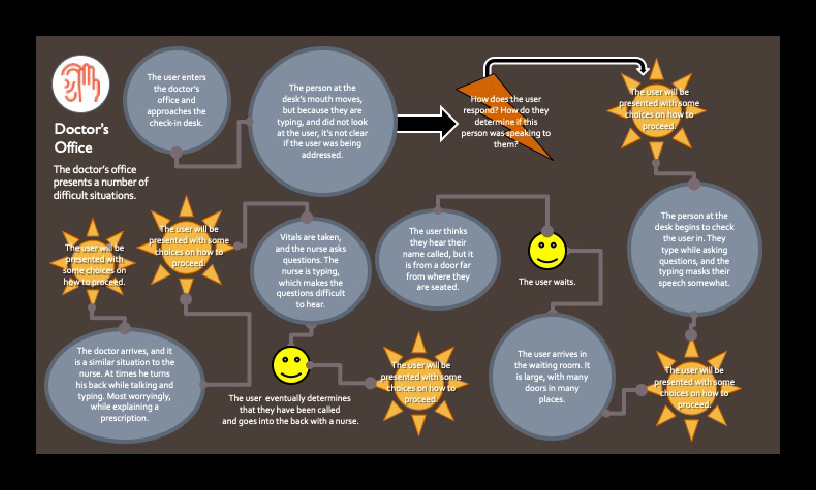
There are a surprising number of ways what we think of as simple activities can go haywire if you can’t hear what the other person is saying.

The Eagle Has Landed
Ladies and gentlemen, we are no longer floating in space.
Designed for DGMD E-55, Creating Educational Media, Harvard Extension School, Fall 2020.
Conceived as part of my thesis, and made much better once I had the means to make it into a learning experience rather than strictly an art project.
Works Cited
Wiggins, Grant, and Jay McTighe. Understanding By Design, Expanded 2nd Edition. ASCD, 2005.
Image credits
The (unmodified) planet image that signifies my entry into the instructional design universe is from the Space Flat Galaxy Radio Icon Set by Chanut is Industries and is licensed under a Creative Commons 3.0 Unported License.